Sunday, 30 January 2011

Fabric testing

I had no idea what some of my fabrics were made from so I decided to use the burn test to help me identity if the swatches were cotton, wool, silk or polyester.

Cotton smells like burning paper and its ashes are soft, fine and turned to dust. The cotton ignites when as the flame draws nearer.

Wool or silk smells like burning hair or feathers. Silk doesn’t burn as easily as wool.
Wool turns black and brittle and can crush between your fingers after being on fire.

Polyester or synthetic fabric smells like chemicals and it turns into hard black lumps. It also curls away from itself and melts.  


At the start I thought the yellow polyester corduroy was cotton but I noticed it burnt with a plastic edge.
I thought the velvet wool cord was polyester but discovered it burnt with a burning hair smell and its ashes were black, hard and crumbly, not a plastic ‘blob’.
Originally I thought the red cotton cord was polyester but it smelt like paper, its ashes were soft and it didn’t create a plastic edge.

Fabric swatches

As a side project at Chelsea, I’m collecting enough fabrics to make swatch book. I have hoarded a whole range of fabrics from school, college, charity shops, friends and family over the past few years that I have well over 150 different types of fabric.
This is great, but it’s created a challenge for me to name and describe all of them. This is an ongoing project for when I get some more.

Saturday, 29 January 2011

Recyling in embroidey

To continue my research into creative I found a really helpful book in the library. Creative recycling in embroidery by Val Holmes. Val Homes is a successful textile designer as well as teacher an author from France. This book focuses on recycling and reusing waste. Recycling is so popular at the moment and its great to find new way to incorporate it into textiles. The book goes through way you can recycling, giving ideas on different techniques. It goes through how to reuse fibre, fabric, paper, plastic, wood, metal and packaging waste.
I really recommend this book for anyone interested in recycling because its just so inspiring.


Theory. Starting my research and essay

I want to use this opportunity to research into Creative embroidery. Embroidery is a skill I like to practise a lot and I enjoy developing my range of stitches and techniques. It’s pretty and traditional, but I want to look at how modern designers use it in a new light. This will allow me to cover a vast range of subjects and to research into many techniques, to then hopefully pinpoint on area that really sparks my enthusiasm. I’m interested in both machine and hand embroidery, although it’s the hand skills that I can really relate to. I’m also interested in how fashion designers use embroidery on garments, stitching on top of print and other experimental styles.
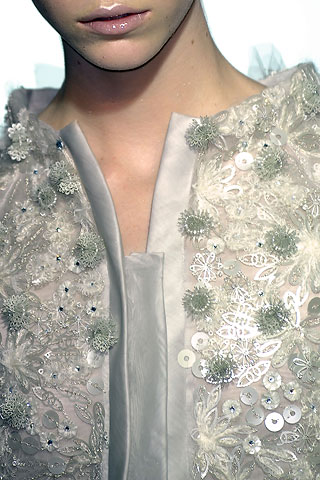
Allessandra Facchinetti for Valentino, fall 2008, created a outstanding collection demonstrating just how creative embroidery has become. The collection is very experimental for Valentino and if anything a little too heavy. But saying this she carried it off beautifully and the embellished dresses and coats are easily wearable.
In an interview Facchinetti tell us her inspiration:
 “I researched embroidery, looked at Van Dyck and contemporary paper sculpture. I was looking for a strong way to interpret romance, but without the usual sweetness”.


An alternative textile designer is Waltraud Janzen. He creates pieces for art purposes, completely using appliqué and machine embroidery. He likes to work with silk to give his pieces a feminine touch.
My favourite piece of his work is the crazy ‘capriccio’ 1990. He’s layered so many threads onto silk that it turns into a colourful mess!


'Bowl' 1990. pieces of silk hand sewn to form a patchwork bowl


'Capirccio' 1990. Hand and machine stitch onto a silk canvas


'secret message' 1989. freehand machine embroidery onto silk.


Friday, 28 January 2011

Consumption lecture

Following up last weeks lecture, this time we looked at how consumerism affects us and the different types of shopper we can be. We talked about the various ways we choose goods and how we can categorise ourselves into the way we make a purchase. These groups are as follows:

· The rational consumer
A free thinking individual who seeks the maximum satisfaction.
· The victim consumer
Getting sucked into the concept that this product will improve your life.
· The rebel consumer
Rejecting the mainstream
· The communicator/ identity seeker consumer
People who want to form an identity and use the goods we buy to express ourselves.
· The social status consumer
Trying to tell everyone how upper class we are
· The explorer consumer
Seeking new pleasure and adventure

I am absolutely the ‘Identity’ consumer. I really do think about what clothes I buy and how this communicates my desired personality.

Digital print.

Using Photoshop is a skill I really enjoy. Although it’s not working with your hands so much in a creative way, I still find it an extremely creative process. I’ve been manipulating images for a few years now, more so with photography, so I have a good understanding of how Photoshop works.
For this block we were asked to complete two digital scarf designs using our drawings. This is great to actually have an item printed and go through the whole design and print process using our own ideas.
I was especially excited by Damien Hirst’s butterfly kaleidoscope designs. They’re so colourful and complex and designed using Photoshop. I choose to use this style but I needed to make sure they were a true representation of my own work, not just a copy. I did this by cutting scanning in my butterfly’s which I cut out of magazines. Then arranging them in a circular pattern I could create my own kaleidoscope motif.


Tuesday, 25 January 2011

The Comfort of Things

The ‘comfort of things’ by Daniel Miller is a book written about a social experiment. Daniel Miller listen and learns from a completely normal street to see what really matters to people and how they live their lives.
It reveals their worries, troubles and stories of the people behind the doors.

We were given a task to read a certain chapter from this book, mine was Portrait 1 Empty. This told the tale of a seventy-five year old man who’s life has never began. I found this text depressing and very uneasy to read.

Here are a few sentences from the text:
“During our time in the street we heard and encountered many tragedies, people who faced all manners of diseases and degradations, who nearly died, who actually dies, whose children had been killed. There is no escaping the horror and tragedy in the interior of peoples lives. But it was particularly after meeting George that we found ourselves in tears after leaving his flat. Because in every other instance there was a sense that, at least, that person had once lived. With George, by contrast, one simply couldn’t escape the conclusion that this was a man, more or less waiting for him time on earth to be over, but who at the age of seventy-six had never yet seen his life actually begin. And, worse still, he knew it.”

George's flat was described as being empty from personal touches.